Above is my Gosford complete with the Overhead. Click on the photo to see the Main North Album at Flickr

Wednesday, July 2, 2014

Learning how to do Scenery on the Main North. It beats doing DCC installs.


Yesterday I posted my first Blog entry in 3 years indicating there have been major changes in my life – retirement, home renovations and most importantly, changes on the Main North. If the activity on this Blog is any indication, many of you here following, thought nothing would happen, well it has and it’s also surprised me.

The renovations have been completed so I have the rest of my life to finish off the painting, landscaping and getting my new “garage/shed” in order, for the moment I’m into trains 24/7, playing, planning and working on my layout. The plywood junction is slowly being replaced with scenery.

Initially I was helped by my mate Brian from Townsville, colloquially known as the “Northern Terrorist” with the scenery on the Murrurundi to Pangela line above Gosford. After Brian returned home, I had to keep the ball rolling, with 3 more sections done. The newly sceniced areas still need the fine detail like ballast, fences, Telegraph Poles, station detail etc. to be added.

With track plan of Gosford completed, I thought I’d better attack the section of track above Gosford prior to installing the “overhead” to minimize damage to the Gosford’s overhead. While planning the scenery prior to Brian’s week at the Main North, I phoned Brian as he lived at Murrurundi in the 70s, I asked if he had a photo of the bridge over the Pages River - no was the answer but he said he’d see what he could do and that was 9.00 pm. At 10.00 am the next morning there were some photos of an NR crossing the Pages River Bridge. Brian’s brother went out and photographed it at sparrows fart.


Now I had to model the bridge. Thanks Kevin and Brian. Using my scaling method and Google Maps, I worked out the bridge should be about 100 scale feet long.
My nearly completed Pages River bridge.. 


The total mainline length of the Double Deck Main North is now 115 metres excluding the two Return Loops at Sydney and Gunnedah, so scenicing the Main North will certainly take some time but a start has been made. I have been surprised with the efforts. Wow what a difference scenery makes, when playing trains on the sceniced Main North. I wish I had started with the scenery, much earlier.

Upper Deck - Murrurundi to Pangela track looking towards Murrurundi with with the Pages River Bridge.

Lower Deck - Gosford looking south with the not yet built station platforms (Platform 1 behind the HUB Cars and Platform 2 and  the grey platform, the Loco (with Turntable) and the Electric and Car Sidings for the 46 Class Electrics and the Interurbans, respectively


Looking back towards Pangela that's located in the "reclaimed space",deep under the house.  


Running further north towards Werris Creek, heading towards the eastern portal of the Ardglen Tunnel. The Tunnel is only a metre long but goes through a right angle, into Ardglen Station.
A small part of Fassifern is shown in the lower L/H corner. 


Exiting the western portal of the Ardglen Tunnel. The future Ardglen Ballast Quarry will be behind the sandstone above the loco/tender. 


Ardglen. Brian made the Station about a year ago, so a better home is long overdue.
Under the two houses on the Hill and behind the large tree in the foreground is the track to the Ardglen Ballast Quarry.
The "white" Newstan Mine Bin can be just seen in the lower L/H corner. and shown below.


Top Deck - Ardglen
Lower Deck - Newstan Mine with 22 loaded BCHs under the Bin ready for the trip to Port Waratah. A second Garratt will light engine from Broadmeadow, shunts the Van onto the BCHs then couples up to the first Garratt. The coupled Garratts push the train on to the mainline. With the complete train on the Down Main the Double Garratts attack the 1 in 40 grade up Fassifern Bank. Using QSI's Heavy Load feature, in these Eureka Models Garratts, this makes a truly magnificent train operation, just like what happened in the late 60s. At Broadmeadow, the Garrattts are "run around" the train then separated. One Garratt is placed in the Yard and serviced while the other Garratt pulls the train into Port Waratah (the Back of Broadmeadow). There is no room for full BCHs so the train continues on via a Sneak Path under Sulphide Junction and back to Newstan Mine with the Garratt and the BCHs re-positioned under the Bin. This takes the operator about 45 - 60 minutes to do.


Fassifern showing the Wakefield Road overbridge.
The Newstan Mine track veers off to the right just beyond the bridge.
I need to paint the house in the foreground, white as this house is very clearly shown in many of the Fassifern photos I have seen.


An overall view of the some of the layout with

R/H lower - North Gosford with the Garratt Sidings and the Up Refuge (22 inch radius) on a curve with the change from steam to a 46 in progress.  
R/H upper - North of Pages River Bridge.
Rear Lower - Fassifern and my "home grown" Sedum Gum Trees. A future topic on the Blog.
Rear Upper - south of and up to (going north), Ardglen Tunnel.


Most trains on the Main North in the mid 60s were steam hauled. Werris Creek bound (Down) trains were assisted over the Range with a "rear end" banker connected to the train at Murrurundi. A second operator is necessary to run the Banker. Two operators working in tandem over this 25 metre section of newly sceniced track with two sound equipped Standard Goods etc, wow what fun.
To make this operation easier and overall running of locos, I "speed match" ALL of my locos to a maximum speed of 30 MPH. Using 28 Speed Step mode, the Procab's Speed display indicates the approximate MPHs of the locos. This makes "banking" a little easier with both loco's s displaying the same an approximate MPH reading.
For extra reading see my previous 30 MPH max speed matching entry in my Blog.

The Grass is made using 6.0 mm long Static Grass from MiniNatur and applied to the layout with a "home made" Grassinator from an article by Ray Pilgrim using a $14 Negative Ion Generator from Oatley Electronics here in Sydney and PVC plumbing parts. A future Blog Topic. Contact me if you want the Grassinator article. 

I have been busy on the layout for the last couple of months. Much more to do but doing scenery is lots of fun and with the results, very rewarding.


Tuesday, July 1, 2014

What's been happening on the Main North since 2011.

I’ve been embarrassed into posting what's happened to the Main North, since October 2011 – not much, until the end of 2013.

I’m now retired. I took redundancy from Qantas in April 2012. With 7 days a week “off”, I cannot get as much done as compared to when I worked. Many retired modellers have said the same.

Mid 2012, I completed my first bit of scenery, the southern entrance to the Tickhole Tunnel, north of Sulphide Junction, complete with my “very small part” of the Cardiff Locomotive Works. Still not painted (July2014) but at least it’s somewhere to deliver goods to.


At the other end of Sulphide Junction is my yet to be painted Sulphide Smelter Works, the final destination for the W44 Concentrate Train. On arrival of the W44 at Sulphide Junction, the load is shunted into the Exchange Sidings by the C35 and an AD60 then the locos are “light engine” to Broadmeadow. The operator then returns to Sulphide Junction where he shunts the wagons into the appropriate Sidings using the “Sulphide Shunter” – a Bachmann 44 Tonner with Soundtraxx Tsunami Micro sound. My first loco paint job with decals from the U.S. Now painting was big deal for me. So I think it turned out okay.


The Sulphide Smelter Works are made up from 3 Cornerstone kits, the Glacier Gravel Works, Power Station and part of a New River Mine kit.


While painting the Sulphide Shunter, I thought I’d paint my Lloyd's C30 Tank that I’d built about 15 years ago. Fitted with a Soundtraxx Micro Tsunami, MRC Speaker & a TCS KA2 Keep Alive. To fit the KA2 under the Coal Bunker, I had to “cut” in two. 


Previously the C30 stopped/stalled on the Double Slip at Fassifern and many of the Points on the layout. The Keep Alive supplies about 5 seconds of power, enough to negotiate the Dead Frogs as I make my Peco Electrofrog Points more DCC friendly. I’m too lazy to add switches/Point motors, resulting in 40 mm of dead track. My Garrats, C35s, C38s, 50s and most of my “all wheel pick up” Diesels negotiate these so I thought it easier to fit a KA2 to the C30 instead of adding switches, wiring etc.

For those that don't know what a C30 looks like, this is it with a Tsunami Micro under the Smokestack, a MRC 20 mm with the housing's back, trimmed off and glue to the Cab Roof and the cut in two KA2 under the Coal Load.  


I also started with my Newstan Mine along with the Loading Bin. Ballasting the mine roads were my first attempt at ballasting. At the same time I made my Fassifern Bank as shown.


That was it for 2012.

Just after Easter 2013, we, well my builder Son Matt, started renovating the home of the Main North, working 7 days a week for 5 months with a few breaks to see his Girlfriend in Melbourne. Along with the normal "non train" renovations that the Boss (Elley) deserved (new kitchen, bathroom, family room, deck etc.), we added a double car Carport with a new driveway and a large shed. Elley says she had to "make" a Builder to get anything done around the House. Well we know that’s not true, I’ve been building a model train “empire”.

In September 2013, Matt said he had done enough and moved to Melbourne, so "finishing off", is up to me. A phone call discussing the lack of progress around the house, Elley said to Matt "You should see what Dad has done in the Garage, he's built over the work bench and added more tracks instead of doing scenery. To top it off, he's put a work bench outside in the Carport." Matt's reply was "You've let him get away with it for years". Some mate that Son of mine, is.

With Matt gone, my thoughts were about trains again and not the house. I “resumed” a 2.0 x 3.5 metre section of the area under the house adjacent to where Gosford is to be located, used for storing junk etc. to be a part of the Gosford “build”. I also moved Matt’s junk from under the layout to another area under the house. This allowed me to add 10.0 m of track between Gosford and Fassifern on the lower deck, eliminating the rear of the Double Garratt Newstan Mine Coal train from entering Gosford as it was shunted onto the mainline at Fassifern – most un-prototypical shunting and on the upper deck 10m of track between Pangela and Ardglen.

The work bench area plus across the “duck under” entry into the other storage area, provides a severely compressed 5.0 m Gosford with and the Electric sidings on the “bend”, Gosford Station and Loco with a 75’ Turntable at the southern end and the steam engine storage sidings including Garratt sidings, at the northern end on a curve into the newly acquired above area. This “peninsular” allows for UP Goods trains to enter the UP Refuge around behind Gosford Yard. The length of both Refuge Loops, allow for the “engine change” that was necessary at Gosford in the 60s for trains up to 3.5 m long, shown below with the the latest scenery above Gosford of the Pages River Bridge and the track from Murrurundi to Pangella.


A week long surprise visit in December by Matt to finish off some projects culminated in a major improvement for the Main North, replacing the solid metal Garage Door with a Stud Wall and a Sliding 800 mm Door. My Main North was going to “sealed” from the elements, at last.

To finish off the now called “Hobby Room” on the Plans, is to get all the “workshop” tools, equipment, drawers etc. out into the new Workshop in the 8 x 5m Pergola without security. For the time being, the valuable tools and equipment are kept in the Hobby Room. Dec 2014 saw walls and two second hand Roller Doors fitted the Pergola. It's now the SHED. 

For 2014, I need to add the second main line out of Gosford and up the Cowan Bank complete with Overhead Wiring, hopefully done prior to the delivery of the Auscision 46 where I’ll need a few for the “change of Engine” at Gosford with 46s to and from Sydney, on most trains.

The SCRMA has just had April 2014 Epping Seminar on Bridges and Culverts. On preparing for my Clinic for the day, I have been motivated to add a 2.1 m Hawkesbury River Bridge to the Main North opposite Gosford, but that along with other Main North additions, they’ll be in the next blog entry, hopefully in a few days.

Monday, October 3, 2011

NMRA X2011 Convention in Sacramento USA.


It's been 6 months since I posted anything on the Main North Blog, so you can come with me on a visit to the U.S, instead. For years I've wanted to attend an NMRA Convention in the U.S. One of the NCE users living in San Jose that I communicate with regularly, suggested many years ago that the 2011 Convention in Sacramento would be the one to attend, as "they" were the host organizers.

In March 2011, Jim Betz another one of my Skype DCC mates asked me if I'd be interested in doing a Clinic on "Decoder Installations" at the Convention, as one of the the regular DCC presenters had pulled out due work/family commitments. As I've done a few presentations here, I said yes. I had three months to put a PowerPoint presentation together so instead of using NSW models, I thought I'd use U.S. models that I borrowed from one of my train mates, Alistair. I even found an Athearn SD40-2 under my layout, very handy for the topic on "Motor Isolation". Heaps of hours spent preparing but finished with plenty of time to spare.

In the meantime, three of my train buddies Laurie, Garry & Alistair decided they'd come with me. I really wanted to "travel" with one mate, 'cause I'm still a Kid and scared to travel by myself as my Wife had declined my offer of accompanying me to the Convention and some sightseeing of the U.S West Coast, so 4 Aussie on the "loose" in the U.S. seeing model trains - how good would it be.

I arrived in L.A. two days before my mates as I travel on Standby. With these days to spare, I'm heading south to San Diego on a 14 lane Freeway travelling at 75 MPH (130 KPHs), with cars and trucks overtaking me - what a driving experience, to visit the La Mesa Club's Tehachapi Loop. Many have said, it's a "must" see layout if you're ever on the U.S West Coast. I'm here, so I'm going!

The Tehachapi Loop is one of four layouts located in the Model
Railroad Museum in Balboa Park. The layout is 150 feet long by 52 feet wide in a double "storey" (not double deck) format. Spent 6 hours talking, taking photos, visiting the Library & culminating with a guided tour of the layout's "innards", after the Museum had closed - what a day.

Top photo shows an aerial view of the Tehachapi Loop with the model on the second storey of the building.

The middle photo shows the Calente on the lower floor with the
mountains in the rear.


The lower photo shows the CTC? Panel under the layout.

For more photos and videos of this spectacular layout, see:

http://www.sdmrm.org/#/the-tehachapi-pass/4533421367

September 2011 Model Railroad Hobbyist's has a video about the Tehachapi Loop layout at:
http://www.youtube.com/watch?v=UCZt3HZKgJA

More Tehachapi Loop YouTube videos


Certainly one of the highlights of my U.S. trip. Well worth if you get to L.A. I could spend a few days at Balboa Park, but I really know where I'd be. See:
http://en.wikipedia.org/wiki/Balboa_Park_(San_Diego)

Drive from San Diego to San Jose via the Big Sur & Monteray. Met up with the other Aussies at the Newark Hilton, the "base" for the Advance Layout Tours around the Bay Area.

Prior to the Advance Tours schedule, Jim offered to open his Cal Central Club layout, for us to have a play and Seth Neumann offered a special "private" operating session for the 4 Aussies, so we're off to an early start.


Cal Central Club - where Jim Betz and Mark Gurries are members, is located in the old 500 square feet, Agnew Depot, right beside the train tracks going to San Francisco - a real surprise with all that OH&S stuff around these days. More details at:

http://www.bayrails.com/layouts2.php?m=calcentral
An overview of the Cal Central from the Dispatcher Desk located above the layout.

I bought a Eureka Models Garratt over for Jim, so the Club layout will have some NSW flavour, now. Jim was really surprised with the Garratt, when it would not pull anywhere near his intended load of 40 Coal Hoppers on the level, let alone up some of the layout's grades.

Some "Cal Central" YouTube videos

Southern Pacific at Cal Central club (HO)


Seth Neumann - "Union Pacific in Niles Canyon" layout where we operated in "pairs" with

Switch Lists, getting permission to enter the Mainline from the Dispatcher in another room, by radio. Our first experience to this sort of "operations".

The photo (top right) shows Garry (red shirt), operating.

The lower photo right, Alistair and me (headphones on), "switching" the Nummi Yard. The Yard Clerk gave us more chores (Cards), to do, re-position cars that has to be done prior to the next Operating Session.

A great night for us 4 Aussies. Also see:


Friday was the start of the Advance Tours. We had opted for the "self drive" option as we'd already hired a rental car (Camry), instead of taking the bus option - saved heaps. Meet at Santa Clara's "The Train Shop", the best model railroad shop in California, then to the local Mexican restaurant where many of the DCC operators, that work in/around Silicon Valley, meet for lunch that's now colloquially called the "DCC Lunch". After lunch and the first of the layouts on Tour:

Jim Vail's - HO/HOn3 14' x 33' plus side rooms "Glenwood & Black Creek NG represents a 1/2 of a mountain division across 2 1/2% grades over Cumbress Pass. The Central California Coast SG loops around the layout emulating the Southern Pacific. Layout 98% sceniced, see:
http://www.youtube.com/watch?v=m7UoV1ZUfkc

John LaBarba - HO/HOn3 20' x 20' Sonara Pacific & Southern Pacific layout, see:


Chuck Catania - HO Chittenden Pajaro & Coyote layout, see:


Jack Burgess - HO 20' x 20' Yosemite Valley RR layout, one of the best layouts in my opinion that I visited.

http://www.youtube.com/watch?v=u0FnxKIha24&feature=related

Jim Dias - HO 16' x 20' Western Pacific layout, featuring Feather River Canyon and the Keddie Wye, in the 1930s, see:


Silicon Valley Lines - Large double deck Club layout, see:


Rick Fortin - The double deck 30' x 49' HO Sierra Western & Santa Fe RR. Proto freelanced extension of the Santa Fe in the early 70s from San Francisco Bay Area to Portland, modelled portion runs from Central Valley town of Chico to McCloud, just south of Mt Shasta. See:

http://www.bayrails.com/layouts2.php?m=fortin
http://www.youtube.com/watch?v=t2gFdtEq5uQ


Howard McKinney - On3 Denver Rio Grande & Western Railroad, 7' x 19' plus 5' x 6', is a point-to-point railroad running between Victoria, Co. and Notell, Colorado in the late 1930's through the early 1940's, no mines but with lush pine forests for the timber for the mining industry in the state.

Ed Loizeaux - New York Central - Valley Division. This large S scale layout represents the NYC in the Catskill Mountains in 1948. Steam is resisting diesel pressure to retire early, but is losing the battle. Hauling long freights and fast passenger trains over the mountainous terrain is a routine daily task on this layout, see:


Bob Brown - O On3 On30 Tuolumne Forks 25'x 34' layout. Scenery is complete and detailed. The railroad is a logging and tourist line with sawmills and a large hotel set in the Roaring Twenties. Also an On30 limestone layout with kilns, a stave mill, and cooperage, shown at the right.


Wayne Floyd - HO 16' x 22' Freelance Southern Pacific in the 1950s, shown right, operated easily by NCE DCC or Aristo-Craft DC. Fully sceniced.

Mainline is SP and branch line is Sierra RR up to a Saw Mill, Looging RR to Logging Camp


Andy Schnur - HO 22' x 48' C&O Allegheny Subdivision with DCC. Mainline extends from Alleghany, Virginia to Prince in West Virginia with staging representing Clifton Forge, VA and Handley WVA. Operating sessions last for 5 hours with a meal break. A really fantastic layout, as you'll see in the YouTube video below:

http://www.youtube.com/watch?v=k2B6xxDRJAM&feature=related

David Parks - Cumberland West - Western Maryland and B&O, HO in a 1200 square feet room with two 40 and 32 train Staging sections, under the layout, most double/triple headed & with sound.

This was the second of the "operating" layouts we participated in, starting at 9:30 am, stop for lunch (provided by Mrs Parks) and then finished operating at 3:30 pm. Hard work but I was comforted somewhat by my operating buddy, a "real" Diesel driver on the Southern Pacific, that said it wasn't anything like that in the real thing. See:


www.youtube.com/watch%3Fv%3DQYfqpA4uUko


Drive to Sacramento, approximately 2.0 hours north of the Bay Area. Travelling in the far left lane as I had more than 2 passengers (like our Transit Lanes), I did not see the Toll Booth signs and went through without paying. $14 fine when I got home.

On the Freeway we had a laugh at a truck we passed (see right), should I say passed us.

At Sacramento, we met some of the other 48 Aussies, some with their wives that attended the X2011 NMRA Convention at "drinks"with some of the NMRA Executive.

The Convention Clinics started on Sunday night through to Saturday morning. Every day there were extra train related activities like a SIG Layout Tour on Wednesday, all day, trips to Portolla, Napa Valley,etc. I missed these as there were too many Clinics I wanted to see. Busy for the whole week. The Clinic Schedule is at:


Up at 5:30 am on Monday morning to return the rental car to the Airport, then onto the Convention to meet Jim Betz who was on at 8:00 am, my first Clinic for the week. 9:30 it was my time to be "up the front" with my "DCC - Installing Decoders" in front of about 100 modellers. After the initial questions of, "we don't understand you", "can you speak up", I slowed down a little and it all went off well - 50 PowerPoint Slides and Questions at the end. I finished 11.10 a little into Jim's next Clinic.

My second Clinic presentation was on 2:30 Friday afternoon, after spending time at The National Train Show held in the ground floor of the Convention Center, a guess at 6 times larger than Liverpool, but I was told, small in comparison to the U.S. East Coast National Train Shows, in the morning and "DCC Lunch" Sacramento style, at the Old Spaghetti Factory.

Clinics I attended were on DCC, Decoder Pro, Signals Dispatcher, Tuning a Tsunami, Joe Fugate's two Clinics. Tony Koester's Double Deck layouts and many more.

A few visits to the Layout Design Sig rooms where Seth Neumann is the coordinator of this group, Byron Henderson is one of the major players in this group, click here for Byron's Blog. Anyone wanting to design a layout for better operation, should visit this group's groups website. Included in the Membership is a Journal

Mark Schutzer a NCE user asked me if  I;d like to co-host a NCE Forum at late notice. About 60 modelers attended on Thursday evening, where we discussed anything to do with NCE and Decoder Pro They and me learnt a lot about the NCE DCC system.

I met a lot of modellers, I've "seen" on the NCE and JMRIuser (Decoder Pro) Yahoo chat groups. A great night.


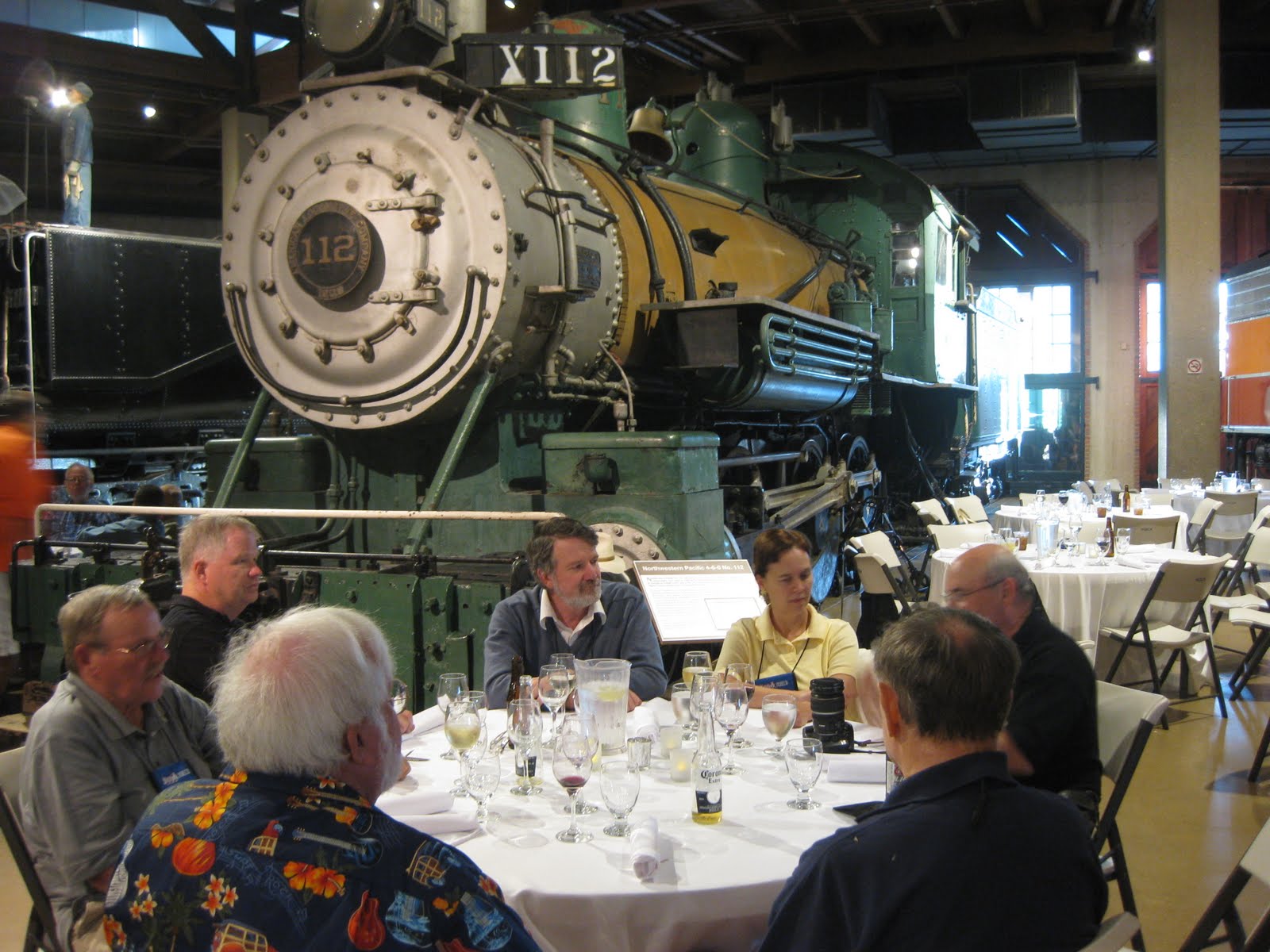
Friday evening, dinner at the Sacramento Railroad Museum organised by the Layout SIG Group, seated amongst the locos, what a finale to a wonderful week. Photo of "my" table with Garry in the middle left and Jim Betz to the left.


After nearly two weeks in the U.S. visiting all these great layouts, clinics on the U.S. prototype, I was feeling like changing prototypes. Once home and saw my beautiful Garratts, there's now way I'm changing.

The only things I purchased for the layout were a few books, some speakers and a Soundtraxx Micro Tsunami sound decoder, so I could ask Soundtraxx, where the on board fuse was located, so I could fix the two I had blown up when initially installed decoders in the Trainorama C32. Nancy and Steve at Soundtraxx willingly obliged my request. Now I've fixed them.

The HO Free-mo Layout shown in the National Train Show Sacramento - Part 2 YouTube video, was one very impressive modular layout, particularly the trees.

What a great two weeks, highlights being: La Mesa's Tehachapi Loop layout, operating on Seth Neumann's and David Parks' layouts, presenting a Clinic to the U.S. modellers, the banquet dinner with all the locos and of course meeting so many model railroaders.

Monday, April 11, 2011

Operating the Track Cleaning "Hanna" Van on the DCC Main North.

At the recent SCMRA Departmental Rolling Stock Seminar at Epping (April 2011) , I did a Clinic on "Loco Sand".

On researching this topic, I found an article in the Jan 85 Roundhouse on Hornsby Depot by Ray Love, detailing the track cleaning operation of the Cowan Bank etc, due to accumulation of sand that played havoc with the signalling system.

On the NSWGR, Main North there was heavy use of sand by locos as they struggled up the Cowan Bank with grades of between 1 in 40 to 1 in 55. In the open, the build up of sand/oil/grime was cleaned away by the rain. With no rain in the tunnels to clean the track , this build up of sand/oil/grime etc made worse by the heat inside the tunnel, affected the signalling system.

In the early 1930s, the Signals and Telegraph Branch experimented with cleaning of the track by fitting 2 Wire Brushes behind the rear bogie of a 30 Class loco. In 1936 the Signals and Telegraph Branch introduced the first Track Cleaning Van with two Wire Brushes, fitted and operated similarly to what was fitted to the 30 Class loco.

Initially the Van was an old American Box style carriage and operated by Syd Hanna. It was destroyed at Hornsby Yard in a shunting accident in 1944. A bogie BHG Goods Brakevan was converted to make a second Van. This Van was affectionately known as the Hanna Van, after it's long time operator.

The BHG Hanna Van was attached to the No 69 Down Pick Up Goods, just ahead of the Brake Van at 5:15 am, every Tuesday and Friday morning and cleaned the rails of the Cowan Bank and Woy Woy tunnels. The Van was detached at Gosford a added to the No 58 Up Pick Up Goods, where it cleaned the rails in the UP direction. Track cleaning was to be done at a minimum speed of 10 MPH where the brushes rotated at 695 RPM. Like the first Van the second "Hanna" Van was damaged again at Hornsby in a shunting accident , in 1950.

A MCV or similar van was modified to to be a third Van until electrification to Gosford, removed the need for such maintenance procedures, where is was withdrawn from service.

I volunteer to do a Clinic to get a model/building onto my Main North layout. Instead of adding a Sand Bin to my two Elevated Coal Stages, I decided I'd build a Hanna Van and add this "operation" of cleaning the track on the Cowan Bank with a Hanna Van.

Firstly I needed to build a "Hanna" Van and then add DCC to it. If I was to make a Hanna Van, I 'd like to make BHG due to it's extra detail (blocked out windows etc) that was not available, instead the MCV that's available from Ian Lindsay Models. One of my mates found me a BHG. I needed to make this a DCC Hanna Van with sound and lights. For sound of the spinning wire brushes grinding away the sand/corrosion etc, I tried a diesel decoder in one of my locos with the notching set to maximum - no good. I tried a Steam decoder at Maximum speed and the "noise" was close enough. What else was I going to use that was cheap. I had an older DSX sound decoder and needed to add a Function decoder, to "operate" it. For the Clinic, I used this set up.

Since then I replaced the Function decoder with a D13SR motor decoder for better "automatic" operation. I had to also add 2 miniature 12 volt relays to operate the sound, lights and sparks. I could have used a combined sound and motor decoder, but did not have one "on hand". The sparks are two 0.8 mm SMD LEDs glued onto the non rotating brushes configured as Firebox Flicker. The under floor illumination lights are four 1.5 Volt incandescent lamps wired in series with a 120 Ohm resistor.

The DSX is set up with address #9 and the D13SR is set up on address #8.
Prior to operating the Hanna Van, select loco #9 and set to Maximum Speed.
Then set up the Hanna Van motor decoder, this case #8, into a Consist with the operating loco in this case 3622 .
Operate 3622 (in consist with #8), to the Tunnel with the Hanna Van.
Stop just outside the tunnel entrance.
Press F1 (No Bells in NSW) and the lights over the Wire Brushes illuminate.
Wait 10 seconds as the operator pretends to lower the Wire Brushes.
Operate the 3622 to move forward.
The grinding sound and sparks start automatically by the motor decoder, as speed is increased above Speed Step 1.
Once finished cleaning the track, stop the loco.
Press F1 that disables the sound, raises the Wire Brushes and turns off the lights.
Drive the loco to Gosford.

Relay 1 is used to enable the sound and to turn on the lights by pressing F1.
Relay 2 connects the speaker via Relay 1, when the speed of the Consist is above Speed Step 1.
The motor output of the D13SR decoder, energizes the Sound (Relay No 2), whenever the speed is above Speed Step 1.
I made a Speed Table with CV67 at "0" and CV 68 - 94 all at "255", using Decoder Pro.

To see how it all turns out, see  my Hanna Van on the layout Youtube at :

http://www.youtube.com/watch?v=6faM4tiI3bY

The No 69 Pick Up will be "staged" at Sydney Staging with 6 wagons including the Hanna Van. To ensure that it "all" works correctly, the operator will firstly "dial up" loco 9 (the Hanna Van) and set it's speed to maximum. He'll then take the loco/train that will be already consisted with the Hanna Van (loco 9), to the first of two Boronia Tunnels (only room for 2) on my Cowan Bank, stopping the train with the Hanna Van just outside the entrance. Press F1 wait 10 seconds for the brushes to lower, then move off. Sound and Sparks will start automatically as the the speed is increased. As the Hanna Van exits the tunnel, the operator will stop the train and press F1, wait 10 seconds (raising the brushes), then proceed to the second tunnel (3 feet away) then repeat the process. After raising the brushes at the exit of the second tunnel, he'll proceed to Gosford where he'll detach the Hanna Van and shunt it into the appropriate siding.

This total operation takes about 20 minutes. The UP No 58 Pick Pick Up, will pick up the Hanna Van and repeat the above operation, cleaning the UP tracks and leave the train in Sydney Staging (Loop). Operations like this, is what I want/need to re-create on my Main North, so the building of the Hanna Van was a fantastic addition to my railway.

Since the construction of the Hanna Van, I have decided to be more specific with my layout "era" and have locked in the mid 60s. Overhead wiring was completed to Gosford in 1960, so I will be fitting the "overhead", when time permits and have purchased some 46 Class Electrics,

The Hanna Van is not operated any longer and is "parked" at Gosford, I don't have Hornsby on the layout. Occasionally I will place the Hanna Van Track Cleaning "operation" Card in an Operating Session for a non era operation.

Wednesday, July 28, 2010

30 MPH Max Speed "Matching" of ALL my Locos.


On my trip to U.S. in July 2011, where I saw about 20 "high tech" mostly DCC layouts and many home and exhibition layouts here in Sydney, I’ve observed that all trains barring a few, are run at speeds below 30 MPH. I wonder how many model railroaders operate their locos at their maximum prototype speeds.

My double deck “Main North” is located in a 30’ X 30’ area, without any long straight runs and many of the curves are 24 inch radius. This means operating at near prototype maximum speeds is impossible. Some trains require double heading of locos. Most steam hauled trains need to be rear end "banked" up the 60 foot climb to Ardglen where a second Operator couples up the Banker engine to rear of the train then both Operators "drive" their loco at approximately 10 MPH, up to Ardglen. "Speed Matching" my locos as below, will help my Operators keep the locos/trains on the track and off the cement floor 5 feet (1500mm) below.

I have restricted (Speed Matched) the TOP speed of all of my locos to 30 MPH and this provides:

1. What I consider a better "finer" control of your locos. Full range of your locos (0 to 100%) is now 0 to 30 instead of 0 to 70 etc, where in most cases you only used "half" the range of the Throttle.

2. ALL locos, operate with a similar "Speed Curve" (loco performance). This is necessary when Consisting/Double Heading locos, and in my case when 2 Operators are "Rear End Banking" a train, easier.

3. Adjusting your Speed Table or CVs 2, 5 and 6 to provide a LINEAR response, the display on my Procab now indicates the approximate Miles per Hour. That is at Speed Step 20 the loco is travelling at approximately 20 MPH as shown etc.

Using a Speedo Car, makes Speed Matching your locos easy, see my  Speedo Car Blog entry. 

As with all my programming, I use Programming On the Main - POM. This method gives you instant results  "out on the track", when Speed Matching, eliminating the necessity of returning to the Program Track to program a loco. 
NOTE: Contrary to what you may heard/read, using POM correctly, no OTHER loco will be programmed. Just follow your Throttle "prompts", reading them all and go slowly.

Connect the Speedo Car to the loco and adjust the Top Speed to 30 MPH. Do this for all of your locos and they'll all be going at the same speed.  

Without a Speedo Car, measuring the speed, nothing too technical - 36 inches of straight track, a Stopwatch and a Calculator like this one at:

Scale Speed Calculator

or
For 36" length of track - 10 Scale MPH takes 18 seconds and 30 Scale MPH takes 6 seconds.

Adjusting the decoder’s CV 5 will provide “close enough” speed matching. You may also need to adjust CV 6 to "half of" CV 5's value, to make the speed curve "linear". When reducing CV 5 and 6, the loco's "take off" may be affected so CV 2 may need re-adjusting to get a smooth jerk free take off.

Some decoders like my Soundtraxx DSDs and the first Tsunamis, do NOT support CV 5 and 6, see your applicable Manual. For theses I reduce the Top Speed by two methods:

1. Selecting a Speed Table in CV 25 and programming CV 66 (Forward) and CV 95 (Reverse), to less than 128 – lower the value, the slower the speed. See Tsunami Manual.
2. Selecting the “User Defined Speed Table” (CV 25 to 16) and making a Speed Table.

For all of my programming, I use Decoder Pro, downloaded free from the Internet and loaded into my Laptop that's connected to my NCE DCC system. See the link at the bottom of this page for details.
  1. Make a Decoder Definition if you don't already have one, for your desired loco.
  2. Select Speed Table Tab.
  3. TICK the "Use Speed Table".
  4. In the "Speed Table Selection" select "User Defined Speed Table".
  5. Place the cursor on the Slider for Speed Step 28 (CV 94) and drag down the Slider to about midway (120).
  6. Then select the "Match Ends" tab under the Table. This will adjust all the intermediate CVs to make a linear line "speed curve".
  7. Select the "Write Changes" Tab.
  8. Decoder Pro will program the appropriate CVs.
  9. Operate the loco at MAXIMUM Speed. For me this is Speed Step 28 when using 28 Speed Steps - NOT 28 out of 128.
  10. Repeat the above Steps 5 to 9 until the Speedo Car displays 30 MPH or your desired Top Speed. Without the Speedo Car, use the Stopwatch and Calculator from above. Note: For HO, the loco should take 6 seconds to travel the 36 inches for 30 MPHs etc.

Fine Tuning the Soundtraxx Tsunamis

Tsunamis “out of the box” provide a too high slow speed and a noticeable jerk between the lower Speed Steps, when using 28 Speed Step Mode. Operation is better with 128 Speed Steps.
My Tsunami adjustments are based on what Bruce at Litchfield Station posted some years ago and a long discussion on Back EMF on the Soundtraxx Yahoo group during June/July2010.

For my above Max 30 MPH Speed Table, I need to use the 28 Speed Step Mode, I’ve fine tuned my Tsunami equipped locos for 1- 2 MPH speed at Speed Step 1 and smooth jerk free acceleration by adjusting a few of the motor performance CVs, using Bruce's following procedure:

  1. Program both CV 3 and 4 (Momentum), to “0"
  2. Program CV 209 to “10”
  3. Progressively increase CV 210, starting with “1”, until the loco moves, at Speed Step 1, albeit a little jerky.
  4. Program CV 209 increasing by 5 until the loco is smooths out.
Reducing CV 212 (default 255), will further slow down the loco.
Using 28 Speed Step mode with the Maximum Speed reduced to a 30 MPH, the voltage increment between Speed Steps is about 1/3 of the default Linear Table, so the jerkiness between Speed Steps has been all but eliminated.

Along with adjusting the Tsunami's CV 209 & CV 210 & zero momentum as above, Gerry Hopkins suggests to adjust CV 213 to 6 & CV 214 to 9 for perfect low speed control on ALL Tsunami 1 decoders.

Steam Chuff Rate or Diesel Notching Speed Steps, may need to be adjusted if you use the 30 MPH Max Speed Table. If this is a Diesel loco, then CV 116 would have been programmed to maybe “46” so the engine “Notches up every 14 Speed Steps”. Re-program CV 116 to “7” or “39”. For Steam, re-program CV 116 to “80” and then test for 4 Cuffs per wheel revolution at 10 MPH. May be time to use the Tsunami Manual or go on line to Soundtraxx at: http://www.soundtraxx.com/

When finished with adjusting the Tsunami, adjust CV 3 and 4 (Momentum) to your desired values.

For a my 2018 YouTube video of Speed Matching two locos using Decoder Pro, click here.

If you have not used Decoder Pro for programming decoders, for details and what’s necessary, see:

Thursday, March 18, 2010

Murrurundi on the Main North

Adding "operations" like "banking" and "double heading" was one of the main reasons for choosing the "Main North" section of the NSWGR in the mid 60s. Murrurundi on the southern side of the Liverpool Ranges during the 60s, had a delapidated Loco Shed and a 60' Turntable. "Down" trains required assistance up the 1 in 40 climb to Ardglen at the summit of the Liverpool Ranges as these train headed north to Werris Creek and beyond. 

Discussion with one of my modeller mates Brian about Murrurundi and some photos being exchanged, prior to his visit to Sydney in March 2010, Brian provided me with a pleasant surprise when he turned up. He bought me a model of the dilapidated Engine Shed. Now I had to tidy up my Murrurundi that required some major re-building of the baseboard and pinching some of Newcastle (see layout plan) to fit in the re-located Turntable. 

For once in my life I bought something for my layout that actually got installed within a few days - a 60' motorised Turntable with 30 degree mechanical indexing. Just what I needed for Murrurundi now that the Shed was closest to the front facia, making the only location for the Turntable, behind the Shed. To turn the loco it takes 45 seconds. I'm impressed with the Frateschi $150 Turntable from Casula. I'll need another one at Willow Tree. 

The photo shows 3666 having a drink from the Parachute Water Crane. A second operator reversing 5259 out of the Shed, to perform one of it's "banker" duties for the day. A green 3635 is waiting it's turn in the Shed, while 3230 has been turned and is being serviced. A Coal Grab will be added here, soon.

With 5259 attached to the rear, both operators will "drive" the train up to Ardglen, some 40' on my layout up the grade, taking about 10 minutes at 10 MPHs. At Ardglen the "banker" (2nd operator), "disconnects and returns 5259 to Murrurundi. Depending on operational requirements, the banker may go through to Willow Tree, where banking is required for UP Goods trains. With Murrurundi Loco now operational, it is going to be busy here, as all trains including the Northern Tablelands Express (double headed), needed assistance going over the 'Range. 
Slow steam hauled Goods trains, due to the fumes and heat build up in the narrow small bore 500 metre Ardglen Tunnel, could not be double headed, they had to be banked from the rear. I'm glad as this "banking" as it creates extra fun for us, as we operate the Main North. 

Adding the above structures Muururundi has been partially sceniced but so much more to add, next a scratchbuilt Station. My excitement at having something looking a little bit like the real thing, needed me to share it with you. Thanks a lot Brian for getting me going with the Murrurundi Shed.

Tuesday, March 2, 2010

Too much to do to update the Main North Blog

It's nearly a year since I created my Main North (mainnorth) Blog. Too much to do, installing sound decoders for others, repairs and upgrades to NCE equipment including upgrades to NCE radio (RB02 & throttles), working on the layout and actually some running of trains, to update this blog. Since I found there are a few of you watching after I visited Ray's blog, I thought I should update you with some of the progress I made in the last few months. First I had to re-new my password (forgot since it's been so long), any of you old fogies out there having the same problem. I fear going out these days as I might forget my address.


Before Christmas, I moved Sydney Staging from under Newcastle to underneath Broadmeadow Yard and included a 22 inch radius return loop. I've been able to include 4 "through" staging tracks under Broadmeadow, the longest 2900 mm, to stage my W44 Concentrate Train with a Garratt & C35.


Having a Return Loop has created a much longer "run" for each operator now. For example for the Newcastle Flyer that's staged at Newcastle, it would be run just to Sydney and "terminate". I'd have turn the loco. Now run the Flyer to Sydney then through the Return Loop and back to Newcastle, where each operator would light engine the C38 to Broadmeadow Yard, service the loco, turn it and L/E back to Newcastle, ready for the next time the Flyer needs to be run. Similar for the Northern Tablelands Express, staged at Werris Creek Station. To Sydney and now back to Werris Creek where the C36 would be turned and the van repositioned at the rear of the train.


In Febuary I modified Suphide Junction but only after I had re-read Byways of Steam 22 and realised there was something wrong with the text and what is in the track diagram, it said "Upon arrival at Sulphide Junction the ore train would cross over to the yard on the Up side of the main lines, then push back into the exchange sidings". Trouble there are was not a crossover to do this. Researched further and secured a copy of July 85 Roundhouse and found a different story. On arriving at Sulphide Junction, the wagons were propelled via a crossover to Exchange Sidings. How was I going to do this, the locos would be in the next room through Tickhole Tunnel and across the brige into Broadmeadow Yard, if I was to copy this movement. I decided to install the "crossover" in reverse and do what the Byways article suggested. When building a layout, you have only so much space and many compromises have to be made. This is one.


For an interum, I made a rough cardboard Sulphide Corporation Smelters Works, so I had somewhere to shunt to and pull out of, for the W44 and Superphosphate S wagon train. Hopefully some time in the near future I can find some time to make a better Sulphide Works, but this will do for now.


I have edited my Cards to be more specific so visitors can understand what they have to do. I'll add some maps etc, but Operating Sessions with my Card system is so much fun. To operate the Double Garratt loaded Coal train from Newstan Mine to Port Waratah, tgen back via a "sneak path" to Newstan Mine and all the BCHs marshalled under the Loading Bin, takes 45 minutes.


In the photo of Sydney Staging (right), a Sydney Fast Electric Parcel Van is getting a "road test" after installing a QSI Revolution sound decooder loaded with a U.S. GG Electric prime mover and a 620 Horn and a NSW Guard's Whistle. I've always wanted to have a Red Rattler 4 car set and now that I have "road tested" a Van, I'm investigating whether this and the 4 car set can "run" on the Main North. They could operate to the end of the photo, where I could make a "Cowan", but this could not justify purchasing them, for this short "run". Maybe a run down the Cowan Bank and into Gosford and back, may be the only "non" prototypical running on the Main North. With at least four 46s operating all trains from Gosford up the Cowan Bank, when Auscision Models release them, the Red Rattlers won't look out of place. What do you think?